Your Furniture is Designed to Fail (And How to Spot the Fakes)
You’re paying good, hard earned money for custom work, and you have every right to expect that the maker is doing it properly. But let’s be honest about the current market: when the economy turns and inflation starts to bubble up, everyone gets an itch for a “side hustle” or other ways to make a quick dollar.
Suddenly, the world is full of guys who have seen a few “cutting board” YouTube videos and decided they carpenters. They see the price tag on a custom table or armoire and think, “I can do that,” completely oblivious to the engineering and physics required to build something that isn’t just wood glued to wood. They also swoon at the price spread between the materials and the sales price of the finished product without realizing that Home Depot and Lowe’s don’t sell lumber to make furniture. There is a massive difference between a professional and someone just trying to keep the party going until they get bored or run out of easy marks.
The Designed to Fail Problem
Commercial furniture manufacturers use nuts, bolts, screws, and cheap, proprietary hardware because they want your furniture to fail. It’s planned obsolescence. They want you to be back in the market for a new dining set in three years.
The side-hustler does the exact same thing, just by accident. They don’t know how to handle seasonal wood movement, they don’t understand structural integrity, and they don’t know how to cut a joint that won’t rattle loose when the humidity changes. Most don’t care to know. They don’t offer returns or warranties; they’re building for the money, not for the legacy.
A proper wood joint is objectively superior…it’s stronger, more flexible, and more resilient than any steel bolt. If the builder isn’t using the proper engineering that has been tested by countless cultures over centuries, they’re just selling you a ticking time bomb of glue and pocket screws that you will be replacing in short time. So how do you spot the different? Well, allow me to toot my own horn.
The Redbud Standard
If you’re hiring a shop, they should be able to explain exactly why they’re using a specific joint. If they can’t, they’re just guessing. Here is what you should look for:
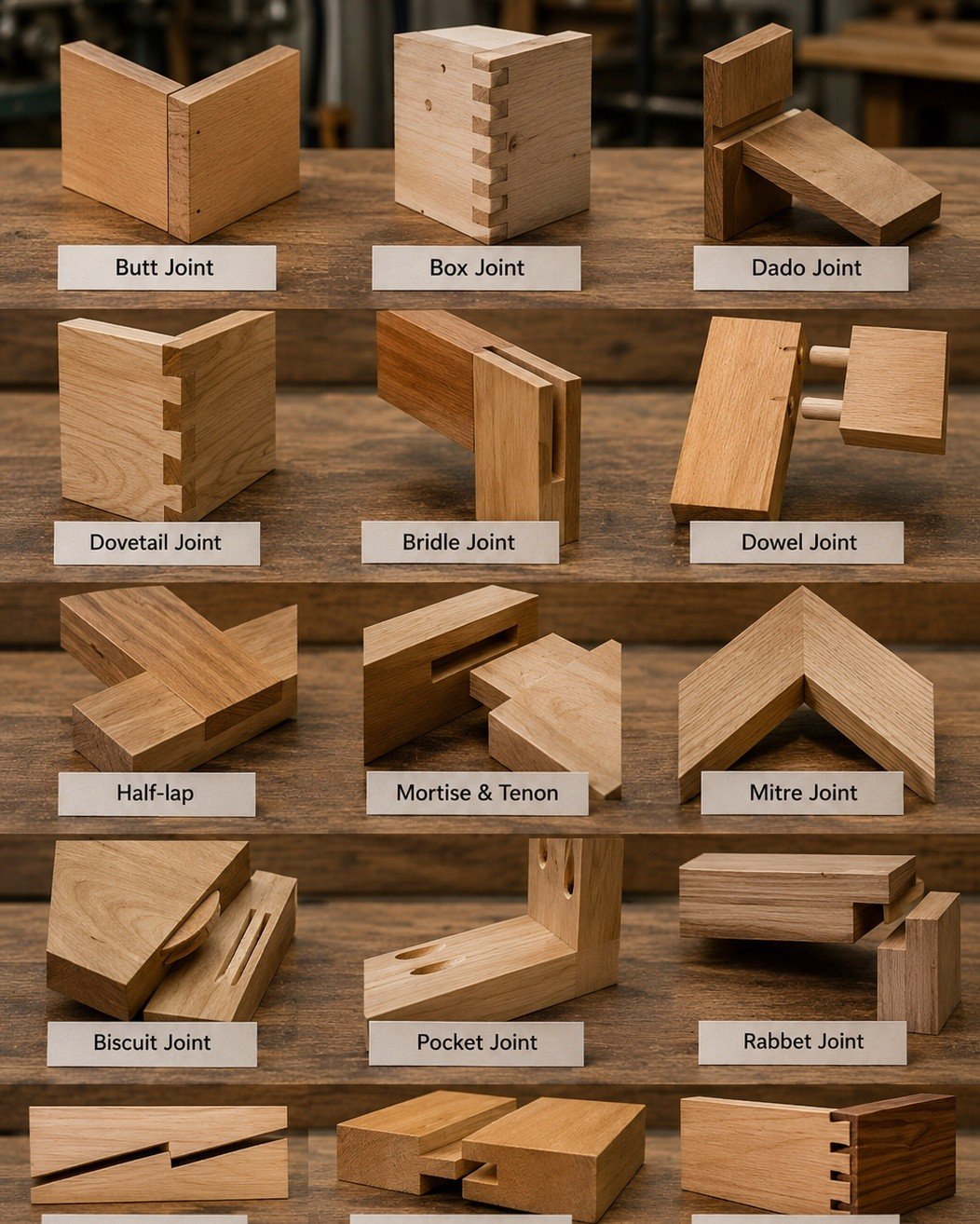
Biscuits: Used for tabletops. They swell to lock the joint and allow the wood to flex naturally with the seasons. All wood moves with humidity. If they skip this, your tabletop will split.
Box Joints: Exceptional strength and easy to square up. These are my go-to for drawers and structural pieces, like the chess board we produced a while back.
Doweling: Deceptively simple, but a nightmare to dial in. When it’s done right, it creates a robust, unbreakable joint for stools and tables. I love doweling rails and stretchers. It is really satisfying when it comes together.
Half-Laps: The backbone of our porch swings. We set them at 15° for the back/seat transition; it’s the only way to ensure the joint stays tight under constant movement, added with the bolts and washers to create compression.
Miters: A non-negotiable for bookcase tops and picture frames. End grain drinks finish differently than the face of the board; miters hide that eyesore for a seamless look.
Pocket Screws: Let’s call them what they are: convenience. They rely entirely on a small screw holding the fibers together at an angle. It’s a mechanical joint reliant upon the shear strength of the screw. We use them for non-weight bearing spots like cabinet carcasses, but if you’re seeing them on a dining table, you’re looking at a piece that will eventually wobble.
Tongue and Groove: The gold standard for wall coverings, doors, and flooring. It locks every plank in place so nothing shifts up or down, but still allows the wood to naturally move. Our old finishing shop had t&g cedar planking instead of drywall. It was freakin’ sweet.
Dovetailing: Beautiful and virtually indestructible. It remains the only way to build drawers for high-end pieces like buffets or armoires. Complex and makes me want to tear my hair out.
Mortise and Tenon: The king of joints. We’ve been using these to hold up chairs and tables since the Renaissance. When a trestle table base is built with heavy mortise joints, you’re looking at a piece you could practically park a car on. It’s the perfect blend of strength and forgiveness.
Bottom line: If you ask a craftsman about their joinery and they give you a blank stare, start rambling about how “the glue is the strongest part,” or tell you that hardware is just as good as a joint…make like a leaf.
You are paying for a piece that should be an heirloom, not a quick project for someone’s side-hustle. Ask questions, check out their work, ask to see their shop. We have to stop buying garbage that is designed, or inadvertently constructed to fail. And it will fail. And it will end up at the dump in mountain of junk.
>Y’all keep making memories around the table,
Mike